The problem
Bangladesh built a machine for moving cash. Not for replacing it.
The gap has four layers. Two out of three shops can't take a digital payment at all. Even the ones that can, mostly don't. The reasons are human rather than technical. And the cost of being invisible to the financial system is measured in billions of dollars of credit that never arrives.
Layer one
Put the shop count next to the merchant count.
The hole is not subtle. It is most of the market.
| Side of the gap | Count | Note |
|---|---|---|
| Small retail shops in Bangladesh≈4.9m units including wholesale and repairAccelerating Asia | ~4,500,000 | ≈4.9m units including wholesale and repair |
| Registered MFS merchant accounts, all providersDec 2024 — counts accounts, not shopsBangladesh Bank | 1,540,000 | Dec 2024 — counts accounts, not shops |
| bKash merchants, the largest single networkGrown at roughly 41% a year since 2018The Daily Star | ~1,000,000 | Grown at roughly 41% a year since 2018 |
| Merchants onboarded onto Bangla QRExpanding toward 1.5mThe Daily Star | ~1,000,000 | Expanding toward 1.5m |
≈ 3 million shops — roughly 2 out of every 3 — have no way to accept a digital payment.
That 1.54 million figure is generous. It counts accounts, not shops, so a shop accepting both bKash and Nagad appears twice. The number of genuinely, uniquely enabled shops is realistically 1.0–1.5 million.
Our estimateBangladesh Bank
1.0–1.5 million shops can take a digital payment. Bangladesh Bank records 1.54m merchant accounts, but those are accounts rather than shops — a shop on both bKash and Nagad is counted twice.
Around 3 million shops cannot. Roughly two in every three. Each dot here is 100,000 shops.
Layer two
Coverage numbers flatter the reality.
What actually flows through the pipe tells the truth. Being signed up and being used are two different things.
~3m
of them cannot accept a digital taka
Shop count less the merchant accounts on record — and those accounts are duplicated across providers, so the true gap is likely wider.
Our estimateBangladesh Bank
5%
of mobile money is someone paying a shop
Tk 86bn of merchant payments a month against Tk 1.72tn of total MFS volume. It was 4.36% in 2021.
early 2025 ·Bangladesh Bank
65%
of transaction value is still not digital
Digital reached Tk 9.23 lakh crore — 34.6% — and about a fifth of that was RTGS, not shop tills.
Oct 2025 ·New Age
Merchant payments are ~5% of all mobile money
Tk 86 billion a month of merchant payments against Tk 1.72 trillion of total MFS volume. Roughly five taka in every hundred on the country's mobile money rails is someone paying a shop. In late 2021 that share was 4.36% — four years of digital transformation moved it a few tenths of a percentage point.
MFS is a cash pipe, not a payment rail
Most volume is cash-in, cash-out and person-to-person transfer. The country built a magnificent machine for moving cash and a very thin one for replacing it.
Cash-out infrastructure has outrun acceptance
1.83 million MFS agents versus 1.54 million merchant accounts. We have taught the country how to turn digital money back into paper. We have not taught the paper to stay digital.
Most accounts are asleep
Of roughly 237 million MFS accounts, only 37.6% are active. Wallet growth has already plateaued into dormancy.
The real problem is not that Bangladesh lacks wallets. It is that Bangladesh lacks tills.
A wallet with nowhere to spend is just a slower way to fetch cash.
Layer three
Every barrier here is human, not technical.
Which is exactly why it is a distribution problem — and why distribution is what we are.
01
The last mile costs more than it earns
Onboarding a shop turning over Tk 4,000 a day, three bus changes from the nearest district town, then training the owner, then fixing a failed transaction next Tuesday. Those unit economics don't work for a corporate sales team. They work for a neighbour.
02
Trust is the actual product
A shopkeeper's float is their family's entire liquidity. “Your money goes into an app” is an enormous ask from a stranger with a lanyard. It is a small ask from someone whose face you see every week.
03
A flat discount rate punishes the smallest shop
A uniform merchant discount rate that a supermarket absorbs invisibly takes a real bite out of a mudir dokan's margin on a bar of soap.
04
Digital literacy is the ceiling, not devices
Smartphone adoption climbed from 63.3% to 72.8% between 2023 and 2025, and Bangladesh counts 187 million mobile and 131 million internet subscriptions. The phones are already there. The confidence isn't.
05
The supply chain is still cash
A shop that takes digital payment from customers still pays its distributor in notes, so the money gets converted straight back. Until both ends move, the middle has no reason to.
06
Nobody owns the relationship after the sale
One-and-done onboarding drives produce merchants who are signed up but never activated. A QR sticker on a wall is not an acceptance network.
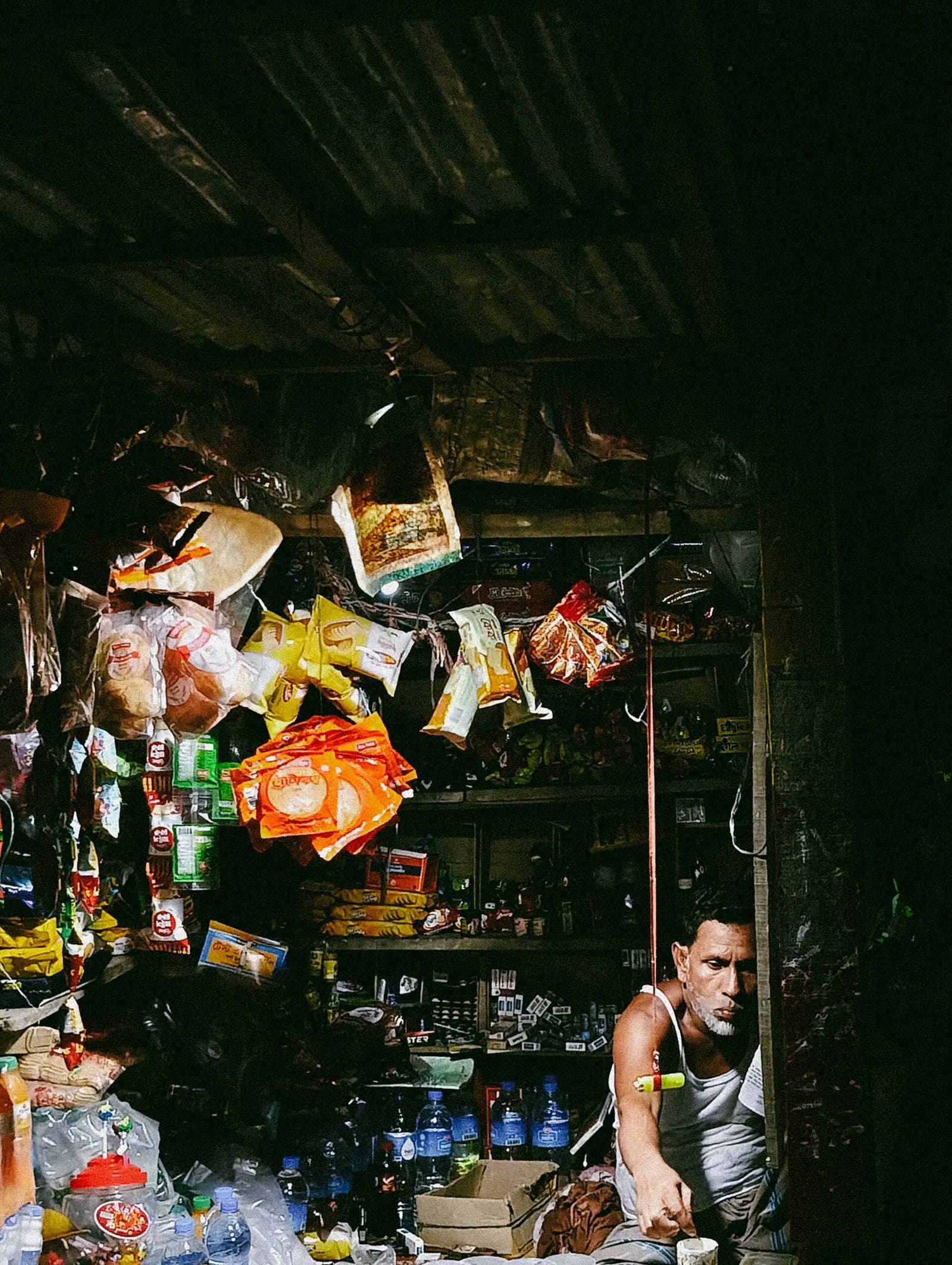
A shopkeeper's float is their family's entire liquidity. “Your money goes into an app” is an enormous ask from a stranger with a lanyard. It is a small ask from someone whose face you see every week.
Layer four
A cash-only shop is not merely un-digitised. It is invisible.
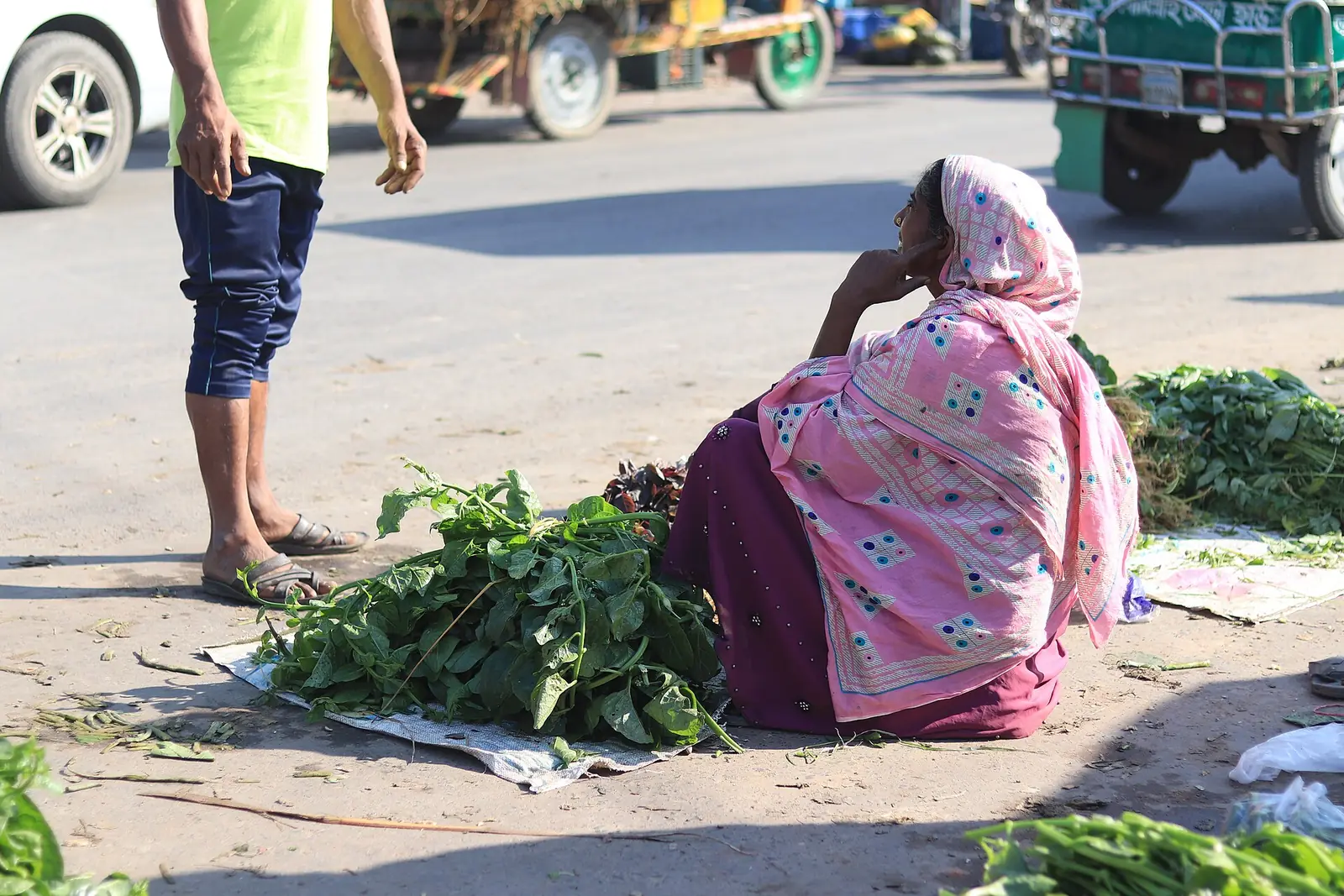
No transaction history means no credit score, no working-capital loan, no insurance, no growth. The gap is a poverty mechanism.
US$2.8bn
MSME financing gap
39.26% of MSMEs are financially constrained. Around 10 million SMEs make ~25% of GDP but receive ~20% of bank lending.
20pp
gender gap in account ownership
More than four times the global average. Bangladesh Bank's own figures: 62.86% of men versus 43.46% of women reach formal financial services.
2025 ·World Bank Blogs
7.2%
of businesses are women-owned
They receive 7.35% of CMSME loans. Closing the inclusion gender gap is estimated to be worth about +14% of national output — some US$50 billion.
And the burden is not evenly shared
Bangladesh's 20-percentage-point gender gap in account ownership is more than four times the global average. Bangladesh Bank's own 2023 figures put 62.86% of men against 43.46% of women reaching formal financial services. Women-owned enterprises are 7.2% of all businesses and receive 7.35% of CMSME loans.
Closing that gap is estimated to be worth roughly +14% of national output — some US$50 billion
Every shop we bring onto the rails becomes a creditworthy business with a history. That is the difference between a merchant account and a livelihood.
Showing our working
How we got to three million — and where we are uncertain.
The load-bearing figure on this site is our own arithmetic, and we label it that way everywhere it appears. It is the census shop count less the merchant accounts on record:
~4,500,000 shops − ~1,000,000 to 1,500,000 uniquely enabled shops ≈ 3,000,000
It is conservative. Merchant accounts are duplicated across providers, so the true uncovered number is likely higher, not lower. Two places we are honestly thin:
- The 4.5 million shop count is an industry figure, not a census figure. The Economic Census 2024 gives 11,702,792 economic units with 41.82% in wholesale and retail trade including motor repair — about 4.9 million — which is a wider category than “small shops”.
- Nagad's merchant network size is not published, so the provider-level breakdown of that 1.54 million is incomplete.
Everything else here is sourced to the Bangladesh Bureau of Statistics, Bangladesh Bank, the World Bank and IFC, or the Bangladeshi business press. If you think a number is wrong, we would genuinely like to know — tell us.
This is our market. It is not a segment. It is the majority.
What follows from this
The shops are reachable. Someone has to go.
Bangla QR made one visit serve the whole ecosystem. The only missing input is people who live in the lane.